
Biological Age vs. Chronological Age: The 4 Markers That Show How Fast You're Actually Aging
Two women sat in my office this month. Both 52.
Both told me they eat pretty well and move most days. Both had a physical last year and were told everything looked fine.
One had steady blood sugar, low inflammation, solid muscle, and cardiovascular fitness in the top quarter for her age.
The other had fasting glucose creeping up, low-grade inflammation running in the background, lean tissue quietly disappearing, and fitness that had been sliding for ten years.
Same birth year. Almost a decade apart underneath.
Here's the part that surprised her: it wasn't genetics. It was four systems. All four are measurable. All four respond when you actually work on them.
A quick confession, since my birthday is coming up
I turn 55 in a couple of weeks.

I spend most of my days as a nurse practitioner caring for people with dementia in nursing homes and memory care. I watch what decades of unmeasured decline look like at the far end of it.
That is exactly why I started measuring these four things on myself. Not because I'm chasing a number. Because I want to know which direction I'm pointed while there's still runway to change it.
What "biological age" actually means
Your chronological age is the number on your license. It only moves one way.
Your biological age is how well your body is actually functioning. Your metabolism, your cardiovascular system, your inflammatory load, your ability to build and hold tissue.
Here's something that trips people up. A standard annual panel is built to catch disease. It's very good at that job. It's just a different job than measuring trajectory.
A CBC and a CMP answer "is anything wrong right now?"
Biological age markers answer "where is this heading, and how fast?"
Both are useful. Most women have only ever had the first one.
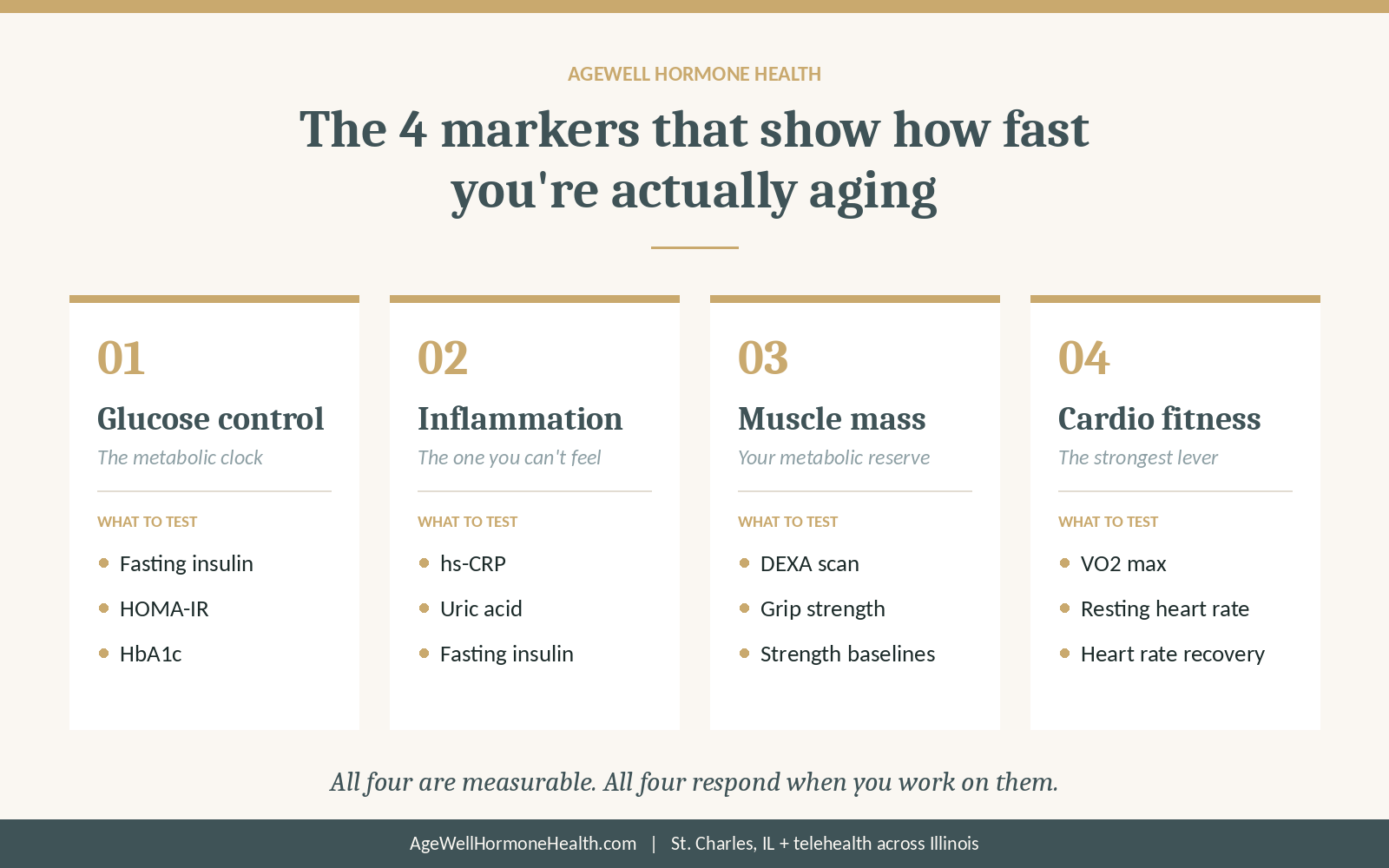
1. Glucose control: the metabolic clock
Your ability to handle blood sugar is one of the earliest places aging shows up.
Insulin resistance does not arrive overnight. It builds for years, often while fasting glucose still reads as perfectly normal.
By the time glucose gets flagged, insulin has usually been elevated for a long time. And elevated insulin drives fat storage, feeds inflammation, interferes with hormone signaling, and ages your blood vessels.
What catches it early:
→ Fasting insulin, not just fasting glucose
→ HOMA-IR, a calculation that estimates insulin resistance
→ HbA1c, your roughly 90-day blood sugar average
→ How your glucose responds to actual meals, not just a fasting snapshot
This is the most workable one on the list. Nutrition, movement, sleep, stress, and in some cases medication can move these numbers within months.
2. Inflammation: the one you can't feel
Chronic low-grade inflammation is the background noise of aging.
It's not like a sprained ankle. No swelling. No heat. No pain you can point to. It just runs, quietly, for years, while it accelerates cardiovascular disease, cognitive decline, joint breakdown, and metabolic dysfunction.
That's what makes it worth testing rather than guessing at.
What reveals it:
→ hs-CRP, a broad marker of systemic inflammation
→ Fasting insulin, which doubles as an inflammatory signal
→ Uric acid, increasingly recognized as both a metabolic and inflammatory marker
I'll often add homocysteine alongside these. It isn't an inflammatory marker, but it's a useful cardiovascular and neurologic risk signal in the same picture.
What pushes inflammation up: poor sleep, visceral fat, chronic stress, blood sugar swings, heavily processed food.
What brings it down: the same handful of inputs that improve everything else on this list.
3. Muscle mass: your metabolic reserve
Muscle is not a vanity metric. I want to be really clear about this one.
Muscle is the largest place your body puts blood sugar. It's your buffer against insulin resistance. And grip strength alone is one of the better predictors of long-term mortality we have.
After 40, most people lose somewhere around 3 to 5% of lean mass per decade unless they are actively building against it. After 70 it accelerates.
By the time it's visible in the mirror, a lot of the tissue that was protecting your metabolism, your joints, and your balance is already gone.
What to measure:
→ DEXA scan, which gives you lean mass, fat mass, and bone density in one test
→ Grip strength
→ Functional strength baselines you can retest
You can build muscle at 45, 55, 65. Starting point doesn't disqualify you. But it takes enough protein (most women eat far less than they think), progressive resistance training, and sometimes hormonal support. Low thyroid function, high cortisol, and the hormonal shifts of perimenopause all make it harder to hold lean tissue no matter how consistently you train.
That last part is the one women get blamed for. It isn't a willpower problem.
4. Cardiovascular fitness: the one that moves the needle most
VO2 max is how much oxygen your body can take in and use when you're working hard.
It is one of the strongest modifiable predictors of how long you'll live. In a Cleveland Clinic study of more than 120,000 people, the mortality risk linked to low fitness was as high as or higher than the risk from smoking, diabetes, or coronary artery disease.
And unlike your genes, it's trainable at any age.
What to track:
→ VO2 max, clinically tested or field-estimated
→ Resting heart rate over time
→ How fast your heart rate drops after you stop
Zone 2 work, meaning sustained effort where you could still hold a conversation, builds the base. Short hard intervals raise the ceiling. When you're starting out, consistency beats intensity every time.
This one often shows measurable movement in weeks.
They all talk to each other
This is the part I love.
Better glucose control lowers inflammation. More muscle improves glucose disposal. Better fitness supports all three.
Once the right inputs are in place, the compounding works for you instead of against you.
And the difference between aging well and aging fast usually comes down to one thing: whether anyone ever measured what was actually happening under the surface and built a plan around what they found.
Curious how old your body actually is?
We can measure it.
A Clarity Session is a 30-minute conversation about your symptoms, your history, and which of these markers are worth testing for you specifically. It's $39, and it credits toward your full workup if you move forward.
Clinical care is available in person in St. Charles, Illinois and by telehealth across Illinois.
This article is for general education and is not medical advice or a substitute for care from your own clinician.